Individual Capacity
In This Section

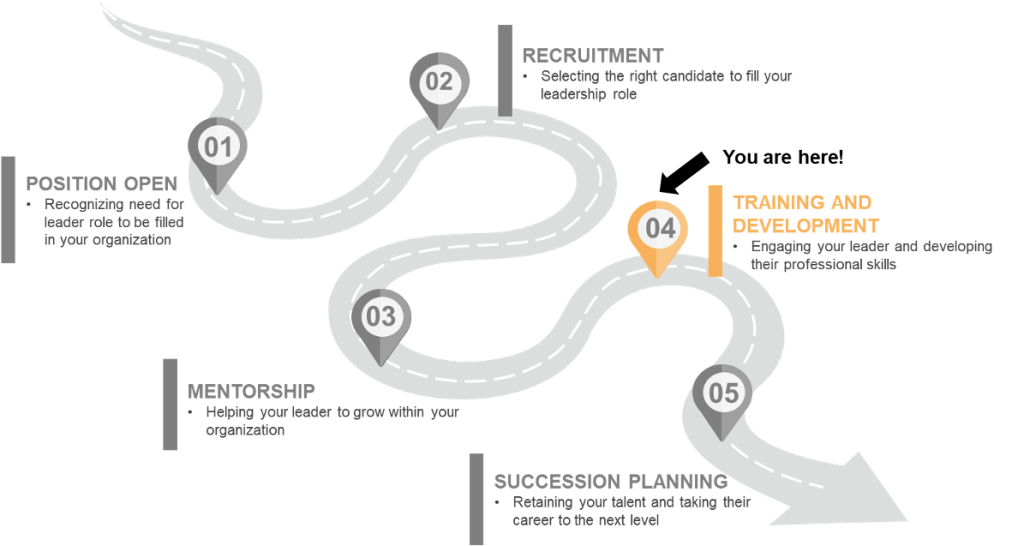
4.0 Pit Stop #4: Training and Development
4.1 Training and Development: Training
Training includes resources provided directly by your organization or externally procured to support your talent in learning new skills and developing new competencies.
leading practices:
- Align training with your organization’s operating goals and use corporate communications to ensure all leaders are aware of opportunities
- Provide training that meets the unique identities of different leaders (e.g. Networking and Personal Branding for Women program)
- Offer trainings that meet the unique learning styles and preferences of leaders, such as lectures, gamification and scenario-based trainings
Specific actions to follow:
- Enable employee resource groups (ERGs) or internal priority-group-based associations to provide formal training or informal “lunch and learns” regarding their communities
- Offer training in-house or through external service providers that teach both soft and technical skills required of your leaders
- Ensure all leaders have equal access to training opportunities and training meets their unique needs
- Promote learning throughout the year as a continuous process, not a one-time initiative
- Review and update your training program on an annual basis to keep up with evolving role expectations
4.1 Training and Development: Growth and Development
In addition to training, there are several other ways your organization can support the growth and development of your leaders.
leading practices:
- Host cultural competency workshops for leaders, in partnership with priority-group-based organizations
- Assign internal coaches to leaders who can work with them to action their growth and development goals
Specific actions to follow:
- Establish professional development programs to help leaders achieve their professional goals
- Promote a culture of continuous learning and development through internal communications and messaging from senior leadership
Training and Development: Regional and Industry Considerations
Industry: Fisheries and Oceans
The ocean sector is lagging behind in attracting a diverse labour force as opportunities in this industry are not highly visible due to their niche, technical training and hiring processes.
To improve inclusion of women and/or non-binary individuals within the sector, consider the following:
- Improve education and awareness that a career in the ocean sector is viable and accessible; partner with women and/or non-binary individuals, allies, and employers
- Sponsor women and/or non-binary individuals to pursue leadership roles within the organizations and encourage them to offer diverse perspectives on company management and talent attraction
- To pursue work as newcomers without prior connections to this field, women and/or non-binary individuals would benefit from additional resources, financial aid (gender issues can complicate pursuit of first-time loans), assets (support to purchase a boat/equipment, obtain a license), access to well-advertised education/financial opportunities, networking and mentorship
Industry: Healthcare
According to a report from Osler, in 2021, only 15% of Executive Officers and 17% of Board Members identified as a woman in the Life Sciences Industry, ranking as the smallest percentage from 13 industries.
Diversity in healthcare is important to ensure equitable healthcare outcomes for staff and patients as well.
Consider the following:
- Provide training to staff to understand the importance of accommodation to meet priority group healthcare needs
- Dedicate leaders to oversee training and partnerships for priority group healthcare education
Scenario: Checkpoint 2

Time's up

Starting the Conversation: 6.1 Asking the Right Questions
6.1 Asking the Right Questions
A leader in an organization is someone who manages a team or several teams, and/or has an important stake in the organization and a role in making decisions that push for change. The following are some questions that you can ask the employees you lead and manage:
- Systemic Barriers to Success
- What are some barriers to your success in this organization?
- Can I play a role in removing some of the barriers? What can I do?
- Creating a Sense of Belonging
- Whose voice or what perspective is missing from this conversation?
- How can I help amplify your voice and that of other underrepresented voices?
- Individual Experiences
- Do you feel safe enough to take risks at work? To contribute? To belong to the community?
- What percentage of your time is spent on addressing exclusion or microaggressions against you or others?
When starting the conversation, creating a safe space by setting ground rules is important. Safe spaces allow individuals to feel comfortable having brave and honest conversations, where one can openly express themselves and their ideas to others on a team without risk of punishment, humiliation, or rejection.
Let individuals know the following:
- “Confidentiality is important, and unless you want me to share information outside of this conversation, I will not do so.”
- “It is important for me to hear your perspective and understand the various inequities faced by employees at work. Doing so, as a leader, it will help me determine ways to remove potential barriers for your success. However, you do not have to partake if you wish not to, and I will respect whatever decision you make.” (To learn more, read the Harvard Business Review article “Getting Over Your Fear of Talking About Diversity”.)
Considerations for Small and/or Non-Profit Organizations
Small or non-profit organizations tend to lack the resources that are readily available in larger or for-profit organizations – time, human resources capacity or budget, etc. – to help them along their Equity, Diversity and Inclusion (EDI) journey. The following are some considerations to help these organizations to begin and continue on their EDI journey:
- Partner with other organizations: If your organization does not have a subject matter expert on staff, seek one out from outside your company. Partner with other similar-sized organizations to pool talent and resources to address EDI within your industry and context.
- Trainings in EDI need not be expensive or complicated:
- Create an exchange program between organizations to access knowledge and training opportunities
- There are high-quality, free materials online that can serve as an excellent starting point to Starting the Conversation.